Satchel Carton Drop Test: 3 Heights and What They Prove
A satchel rarely arrives damaged at the leather. It arrives with a bent D-ring, a buckle that no longer closes, or a corner that has been pushed in far enough to crack the finish. All three are packing failures that a carton drop test finds in half a day, and all three are invisible in a photo of the bag on a table. The test is three drops in a fixed order, and the order is the part most suppliers skip.
Why a Satchel Fails at the Corner Before the Leather
A soft bag absorbs a drop by deforming. A satchel has hardware bolted to five of its weak points: two buckles on the flap, two D-rings where the shoulder strap attaches, and feet or studs on the base. Those parts do not deform, so the energy of a drop goes into the leather around them and into whatever the hardware lands on.
That is why the corner is the first thing to test. A corner drop puts the entire carton weight through a few square centimetres, and the bag inside is usually sitting corner-down in the carton unless the packing was designed to prevent it. If the corner survives, the rest of the sequence stays meaningful. If the corner fails, the second and third drops are measuring a damaged bag.
Setting Three Heights From the Carton You Actually Ship
Drop height is not a single number. Parcel standards set it from the weight band of the package, so a carton of twelve PU satchels lands in a different band from a carton of forty mini bags. Look up the band for your own carton weight instead of copying a number from another supplier.
Test three heights around that band rather than at it: the band height itself, roughly half of it, and roughly one and a half times it. The three answer different questions. Half the band tells you whether the packing protects the bag when the carton is handled well, which is the floor of your quality. The band height tells you what the courier will do on an average day. One and a half times the band tells you what happens on the bad day, and whether the failure is a bent part or a torn bag.
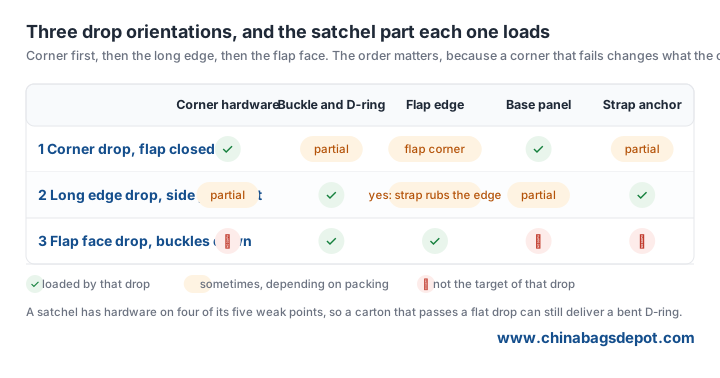
Drops 1 and 2: Corner and Long Edge
Drop one is a bottom corner, flap closed, buckles fastened. Open the carton afterwards and look at three things before you touch anything else: whether the corner of the bag has been compressed into a fold that stays, whether the base panel has creased, and whether the corner hardware has moved in the leather. A D-ring that has rotated in its anchor is a warning sign even when nothing is bent, because the leather around the anchor has already stretched.
Drop two is the long edge, side panel flat to the floor. This is the drop that tests the strap and the flap edge, since the shoulder strap usually lies against one side inside the carton and the bag lands on it. Look for a scuff line on the flap edge and for the strap anchor stitching. Stitching that has pulled at the anchor shows as a row of small white points where the thread has tensioned; it has not broken yet at this height, and it is the earliest reliable signal.
Run both drops in one carton only if the first passes. A carton reused after a corner failure is testing a bag that has been through something worse.
Drop 3: Flap Face Down, Buckles Down
The third drop is the one buyers leave out, and it is the one that produces the returns. Flap face down, buckles taking the impact. On a satchel the buckles sit proud of the flap by several millimetres, so the whole carton weight lands on two small metal or plastic parts and the leather behind them.
Open the carton and check the buckle bodies first, then the flap leather directly under each buckle. A buckle that has taken a set, meaning it no longer sits flat when closed, will be reported by the end customer as a buckle that will not stay shut. Leather under a buckle that has been compressed shows as a shiny patch, and that patch is where the finish will crack in use. Neither failure appears in a flat drop test, and neither is repairable at the warehouse.
Reading the Pass: What to Photograph and What to Reject
Photograph each carton before it is opened, from the dropped face, with a rule against the impact area. Then photograph the three inspection points per drop: the impact point on the bag, the hardware nearest the impact, and the stitching around that hardware. A drop test without those three frames per drop is an anecdote.
Reject the carton, not the bag, when the damage is a compression fold or a crease in the base panel: that is a packing problem and it will repeat in the bulk run. Reject the sample when a buckle body has bent or a strap anchor has pulled, because packing changes will not fix those. That distinction decides who pays for the fix.

Fixing the Cause Before the Bulk Run
Most satchel drop failures are fixed with packing rather than with the bag. Corner protection, a divider that stops the bag sliding into the corner, and tissue around the hardware so it cannot land metal-first are all cheap changes. Ask which of the three the supplier will change, then ask for the revised packing to be drop tested rather than approved on a drawing.
Put the heights, the orientations and the acceptance points into the purchase order as a one-page annex. Then the test is repeatable on the pre-production sample and on the next order, and a packing change shows up as a change in the results.
Send us your satchel spec and the carton weight you expect per export carton, and we will run the three drops on a sample from the satchel range and send the photographs with the numbers before you place the bulk order.
Need custom bags for your next project?
Send your bag style, size and print artwork for a quote and a digital proof.
Get a free quote


