Shoulder Bag Strap Drop: How to Specify Length by Market
Strap drop is the vertical distance from the highest point of the strap to the top edge of the bag body, measured with the bag loaded. It is the single number that decides whether a shoulder bag sits under the arm, hangs at the hip, or slides off entirely — and it is the number most often left off a purchase order. A buyer who specifies only total strap length usually gets a bag that fits one market and returns in another.
What Strap Drop Measures and Why One Number Fails Three Markets
Total strap length and drop are not interchangeable. For a strap attached at two top corners, total length is roughly twice the drop plus the distance between the attachment points. Two bags with the same 110 cm strap can therefore hang at very different heights depending on how wide the body is. Write the drop, and derive the strap length from it.
Drop also has to be measured loaded. A 2 mm leather strap stretches under 3 kg of contents, and a PU strap with a woven core stretches less but still moves. Measure on an empty bag and you approve a number that will be 1 to 2 cm longer in the customer hands.
The reason one number cannot serve every market is body height and clothing. The same 28 cm drop that sits comfortably on a 168 cm wearer in a light jacket will not clear a heavy coat, and will hang too low on a 155 cm wearer. Retailers in different regions have settled into different ranges because their customers dress and carry differently, not because of fashion alone.
Market Ranges: Asia, Europe and the Gulf
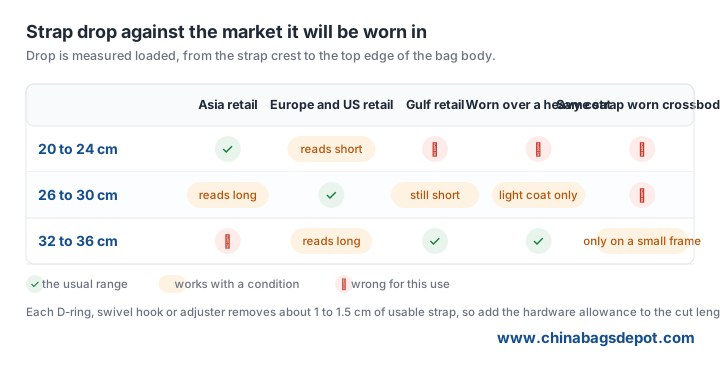
For women bags sold in Japan, Korea, China and Southeast Asia, a single shoulder strap with 20 to 24 cm drop is the working range. It tucks the bag under the arm, which is what the retail floors there show, and it suits a smaller average frame. Below 18 cm the bag crowds the armpit and the top zip becomes hard to open while worn.
Europe and North America sit higher, usually 26 to 30 cm, because the bag is expected to hang clear of a coat shoulder and to be reachable with one hand. In the Gulf and wider Middle East, 30 to 36 cm is common: the bag is worn over an abaya or a layered outfit, so the strap has to clear thicker fabric and usually runs longer than a European spec of the same style.
Crossbody use is a separate line on the spec. A crossbody strap is normally 100 to 130 cm total and adjustable over a range of at least 20 cm, because it has to fit over a coat in winter and still sit at the hip in summer. If the style is sold as both shoulder and crossbody, specify a detachable extension rather than one long strap that looks slack when doubled.
Where the Strap Attaches Changes the Number
Two top-corner attachments give a predictable drop and are the easiest to specify. A single attachment at one side, a ring at the gusset, or a strap that runs through a top channel all change the hang angle, and the drop on the tech pack has to state the attachment style as well as the length.
Hardware eats length. Each D-ring, swivel hook and adjuster removes roughly 1 to 1.5 cm of usable strap, so an order specified at 26 cm drop with three hardware pieces often arrives at 23 cm. Add the hardware allowance to the cut length rather than learning it on the sample.

How to Write the Spec So the Factory Measures the Same Way
Put four lines on the tech pack: drop in centimetres measured loaded, attachment points, strap width in millimetres, and the adjustment range if the strap is adjustable. Add a drawing that shows where the measurement starts and ends, because a factory measuring to the seam line and a buyer measuring to the top edge will disagree by a centimetre on every sample.
Strap width belongs in the same block. A 15 mm strap on a heavy bag cuts into the shoulder; a 25 mm strap on a small evening body looks out of proportion. Width also sets the hardware size, and hardware size changes the allowance described above.
Tolerance should be stated as a number, not left to trust. Plus or minus 1 cm on drop is achievable on a cut-and-sew line; asking for plus or minus 2 mm means every strap is measured individually and the cost reflects it.
Checking Drop on the Approval Sample
Hang the loaded sample from a hook, let it settle, and measure from the strap crest to the top edge at the centre of the opening. Repeat on the left and right side: a difference of more than 5 mm means one strap was cut short, and that bag will sit crooked on every wearer.
Then test the fit on a person rather than a mannequin. Have someone of the target market height wear it over the clothing it will be worn with, and check two things: does the bag sit clear of the elbow when the arm swings, and does the strap stay on the shoulder when the wearer bends forward. Both failures are drop problems, and both show up in returns as "does not stay on".
Record the measured drop, the strap width and the hardware count on the approval sheet. When the production run arrives, measure three bags from the first carton against those numbers — it takes ten minutes and catches a cut-length error before the container ships.
Browse the shoulder bag range for body shapes and attachment layouts, then send the market you sell into and we will confirm the drop and strap length before cutting.
Request a free sample and quote with your target market, preferred drop and strap width, and we will build the sample to that measurement rather than to a stock length.
Need custom bags for your next project?
Send your bag style, size and print artwork for a quote and a digital proof.
Get a free quote


