Travel Bag Sourcing: 5 Fabric and Frame Decisions
Travel bag sourcing starts with two decisions that are hard to change later and easy to get wrong on a quote: the fabric denier and the frame. Denier sets how the bag survives an airport carousel; the frame decides whether the bag keeps a shape on a retail shelf and whether a wheel can be mounted on it at all. Everything else, from the zip to the logo, is adjustable at sampling. Get those two wrong and you are re-cutting a whole run.
Fabric: What 600D and 1680D Actually Differ In
Denier measures yarn mass per 9,000 metres, so 1680D carries about 2.8 times the yarn of 600D in the same weave. That gives a thicker, heavier hand and better resistance to abrasion, and it also gives a fabric that is harder to fold, harder to print on and roughly heavier per square metre. None of that tells you which one survives an airline. For that, ask for the abrasion result in the test report, not the denier on the swatch card.
Two 1680D fabrics from different mills are not interchangeable. Coating weight, backing and weave density move the abrasion figure more than the denier does, which is why a 600D with a heavier PU backing can outlast a light 1680D in a Taber test. Request the report with the test method named, and ask which face was tested: coated side, uncoated side or both.
Coating and Water Resistance
A PU coating on the back of the shell is the normal answer for travel. It stops water reaching the contents through the weave, and it does nothing for the seams or the zip, which is where a bag actually leaks. If the buyer expects rain resistance, specify taped or sealed seams and a zip with a storm flap, then test by filling the bag with newspaper and standing it under a shower head for two minutes. Newspaper that stays dry is the result that matters, and it is repeatable at any factory.
PVC coating is cheaper and heavier, and it cracks at fold lines after a few seasons of compression in a wardrobe. For a bag sold as a one-trip promotional item, that is acceptable. For a bag sold as luggage, it is a return.
Frame: Soft, Boarded or Moulded Shell
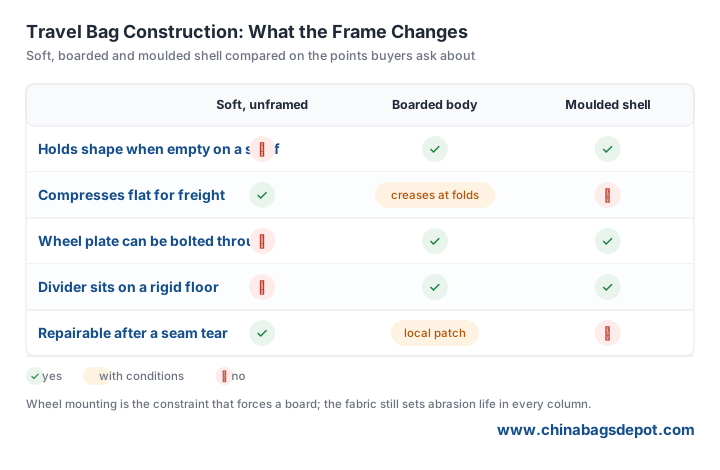
A soft bag with no frame compresses flat, which saves freight and shelf space, and it will not stand up on a display table without help. A boarded bag carries a rigid sheet in the base and sometimes the ends, so it holds a rectangular footprint and can take a wheel plate. A moulded EVA or ABS shell holds a shape permanently and costs a mould, which only pays back at volume.

The internal divider is where the frame decision shows up in a sample. A shoe compartment needs a rigid floor panel and a divider stitched to it; on a soft bag the same divider sags, the shoes sit on the clothes, and the compartment becomes a marketing line rather than a feature. Photograph the bag loaded, not empty.
Hardware and the Wheel Housing
Wheels are a structural decision, not an accessory. A wheel needs a plate or a board to bolt through, so a soft bag either gains a base board or loses the wheels. Once the board is in, the base seam carries the whole loaded weight on two small points, which is why the base is bar-tacked and often double-stitched. Ask for the stitch pattern at the wheel mounts and the board thickness in millimetres.
The handle is the second structural point. A telescoping handle needs a rigid back panel to guide the tubes, and that panel changes the interior depth. If the sample has an unlined back, the tubes will rub through the shell lining within a season. Confirm the tube channel is lined and that the handle locks at two heights.
Five Decisions to Lock Before Sampling
Denier and mill. Name the mill, not just the denier, and keep a sealed swatch as the reference for bulk comparison.
Coating and seam treatment. Coated side in or out, coated weight, and whether seams get tape. A bag with an uncoated seam is not water resistant regardless of the shell.
Frame type. Soft, boarded or moulded, with the board thickness and position. This is the line that controls the mould cost and the freight volume.
Wheel and handle hardware. Wheel diameter, plate fixing method, handle tube lining and lock positions. Substituting a smaller wheel later changes the bag geometry.
Interior layout. Shoe compartment, wet pocket, laptop sleeve. Each divider needs a mounting surface, so each one is a frame decision in disguise.
What to Write on the Order
Fabric with mill and denier, coating type and weight, frame type with board thickness, wheel and handle specification with fixing method, interior layout with divider attachment, and the acceptance test: loaded drop, shower test on newspaper, and a handle pull test at the stated load. Add the cabin dimensions if the bag is sold as carry-on, because an external pocket can push a compliant body over an airline gauge.
Send the trip length, the load you expect the bag to carry and whether it ships as carry-on or checked. We will quote a soft and a boarded version at the same size so the freight and mould difference is visible before you commit, and ship loaded samples for a handle and wheel check. See the full travel bag range for body shapes that already carry a board.
Need custom bags for your next project?
Send your bag style, size and print artwork for a quote and a digital proof.
Get a free quote


